Charge Discontinuity Induced Polarization Enhancement and Head-to-Head/Tail-to-Tail Polarization Configuration at Multiferroic/Ferroelectric BiFeO3/PbTiO3 Heterointerfaces
- Abstract number
- 95
- Event
- European Microscopy Congress 2020
- Presentation Form
- Submitted Oral
- DOI
- 10.22443/rms.emc2020.95
- Corresponding Email
- [email protected]
- Session
- PSA.3 - Semiconductors & Devices
- Authors
- Dr Ying Liu (1, 2), Prof Yin-Lian Zhu (1), Dr Yi-Xiao Jiang (1), Prof Yun-Long Tang (1), Prof Yu-Jia Wang (1), Prof Xiu-Liang Ma (1)
- Affiliations
-
1. 1. Shenyang National Laboratory for Materials Science, Institute of Metal Research, Chinese Academy of Sciences
2. Catalan Institute of nanoscience and Nanotechnology
- Keywords
Ferroelectrics; Interfaces; Cs-corrected TEM
- Abstract text
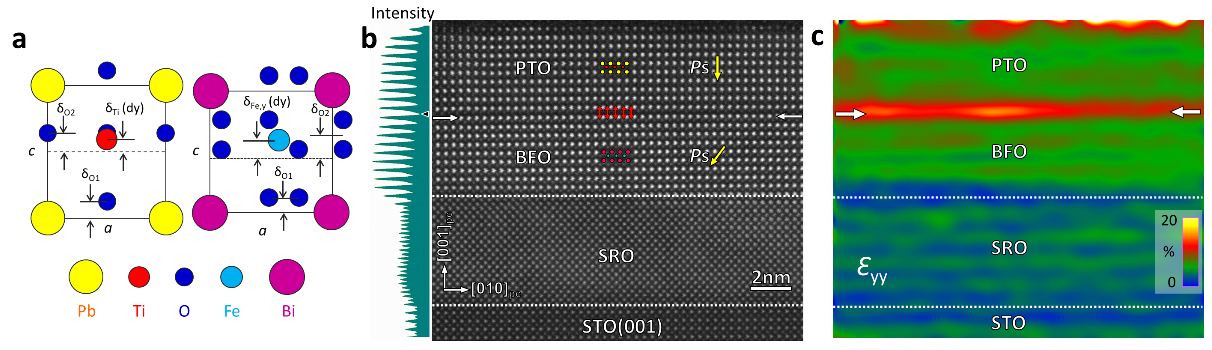
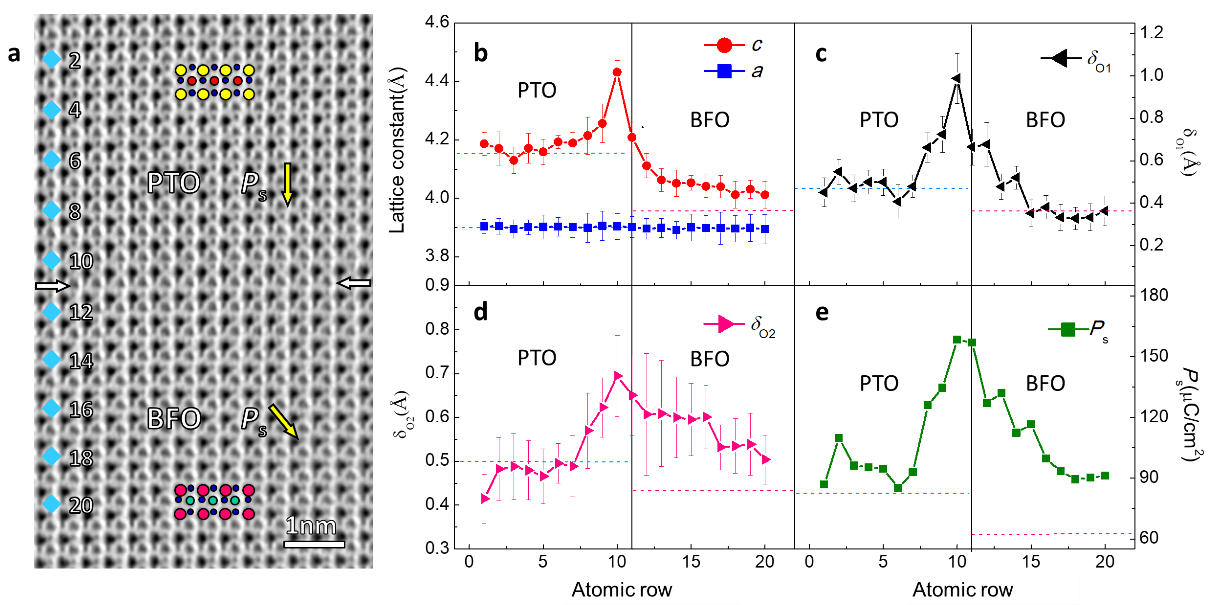
Functional oxide interfaces have received a great deal of attention owing to their intriguing physical properties induced by the interplay of lattice, orbital, charge, and spin degrees of freedom [1]. Ferroelectrics hold promise for sensors, transducers, and telecommunications [2]. With the demand of electronic devices scaling down, they take the form of nanoscale films. However, the polarizations in ultrathin ferroelectric films are usually reduced dramatically due to the depolarization field caused by incomplete charge screening at interfaces, hampering the integrations of ferroelectrics into electric devices [3]. Here, we designed and fabricated a ferroelectric/multiferroic PbTiO3/BiFeO3 system grown on SrRuO3/SrTiO3 (100) substrate, which exhibits discontinuities in both chemical valence and ferroelectric polarization across the interface. Aberration-corrected scanning transmission electron microscopy study reveals an 8% elongation of out-of-plane lattice spacing associated with 104%, 107%, and 39% increments of δTi, δO1, and δO2 in the PbTiO3 layer near the head-to-tail polarized interface, suggesting an over ∼70% enhancement of polarization compared with that of bulk PbTiO3. In addition to that in PbTiO3, polarization in the BiFeO3 is also remarkably enhanced. Electron energy loss spectrum (EELS) and X-ray photoelectron spectroscopy (XPS) investigations demonstrate the oxygen vacancy accumulation as well as the transfer of Fe3+ to Fe2+ at the interface. On the basis of the polar catastrophe model, FeO2/PbO interface is determined. First-principles calculation manifests that the oxygen vacancy at the interface plays a predominate role in inducing the local polarization enhancement [4].
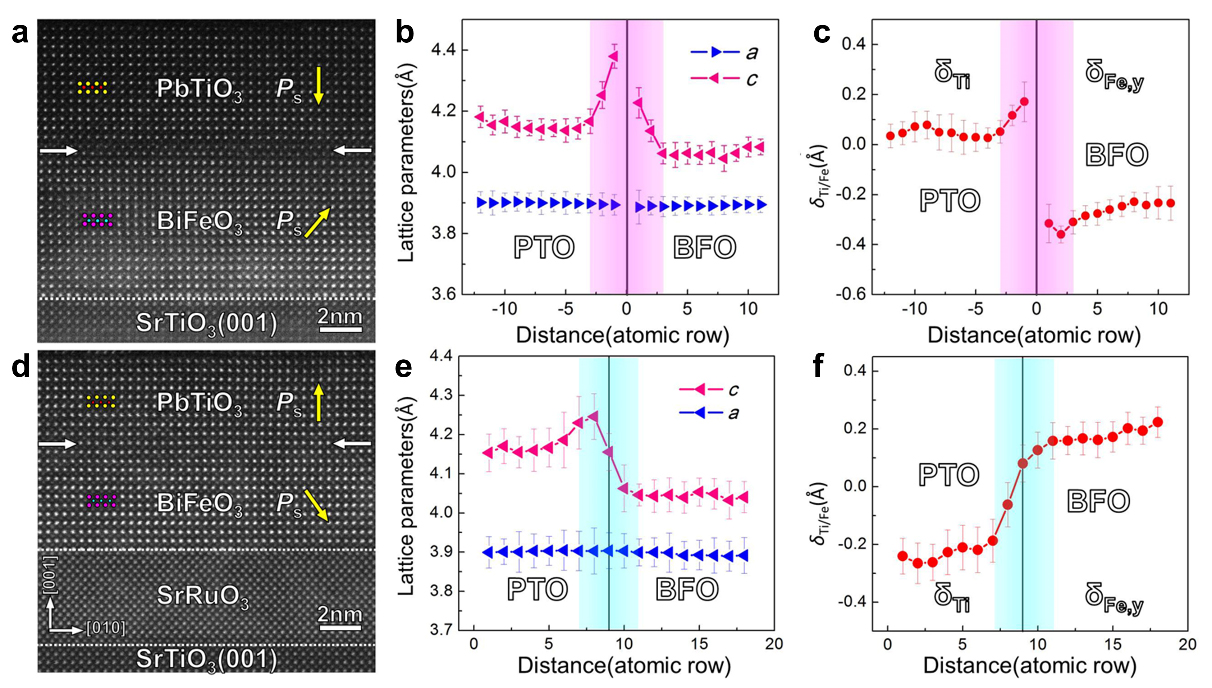
Besides the giant polarization enhancement at the BFO/PTO interface, both head-to-head positively charged and tail-to-tail negatively charged BFO/PTO heterointerfaces were successfully fabricated by controlling electric boundary conditions of the BFO/PTO film system. Aberration-corrected scanning transmission electron microscopic mapping reveals a head-to-head polarization configuration present at the BFO/PTO interface, when the film was deposited directly on a SrTiO3 (100) substrate. The interfacial atomic structure is reconstructed, and the interfacial width is determined to be 5 ~ 6 unit cells. The polarization on both sides of the interface is remarkably enhanced. Atomic-scale structural and chemical element analyses exhibit that the reconstructed interface is rich in oxygen ions, which effectively compensates for the positive bound charges at the head-to-head polarized BFO/PTO interface. In contrast to the head-to-head polarization configuration, the tail-to-tail BFO/PTO interface (with TiO2/BiO termination) exhibits a perfect coherency, when SrRuO3 was introduced as a buffer layer on the substrates prior to the film growth. The width of this tail-to-tail interface is estimated to be 3 ~ 4 unit cells, and oxygen vacancies are supposed to screen the negative polarization bound charge. This study may facilitate the development of nanoscale ferroelectric devices by tailing the coupling of charge and lattice in oxide heteroepitaxy [5].
Figure 1 (a) Schematics of PTO and BFO crystallography structure; (b) A HAADF-STEM image of PTO/BFO thin film grown on SRO/STO (100) substrate; (c) Geometric Phase Analysis of out-of-plane lattice strain of the thin film.
Figure 2 (a) An ABF-STEM image of the BFO/PTO interface; (b-e) lattice constants, O1, O2 displacements extracted from (a); (e) Calculated out-of-plane ferroelectric polarization of the BFO/PTO thin film.
Figure 3 (a-c) A HAADF-STEM image, lattice parameters and Ti/Fe displacements of the head-to-head positively charged BFO/PTO interface; (d-f) A HAADF-STEM image, lattice parameters and Ti/Fe displacements of the tail-to-tail negatively charged BFO/PTO interface.
- References
[1] H. Y. Hwang, et al. Nat. Mater. 11 (2012) p. 103
[2] M. Dawber, et al. Rev. Mod. Phys. 77 (2005) p. 1083
[3] C. L. Jia, et al. Nat. Mater. 6 (2007) p. 64
[4] Y. Liu, et al. Nano Lett. 17 (2017) p. 3619
[5] Y. Liu, et al. ACS Appl. Mater. Interfaces 9 (2017) p. 25578
[6] The authors gratefully acknowledge funding from the National Natural Science Foundation of China (Nos. 51231007, 51571197, 51501194, and 51401212), National Basic Research Program of China (2014CB921002), and the Key Research Program of Frontier Sciences CAS (QYZDJ-SSW-JSC010).